What Is the Marginal Rate of Technical Substitution (MRTS)?
The marginal rate of technical substitution refers to the speed at which one input, such as labor, can be replaced with another input, such as capital, without altering the resulting output level. On a graph, the isoquant is a curve that displays all possible combinations of the two inputs that produce the same amount of output.
Basics
In economic theory, the Marginal Rate of Technical Substitution (MRTS) signifies how diminishing one factor compensates for an increase in another, ensuring consistent productivity levels. It intricately captures the interplay between crucial factors like capital and labor within a firm, facilitating sustained output. Notably, MRTS distinguishes itself from the Marginal Rate of Substitution (MRS) by centering on producer equilibrium, whereas MRS pertains to consumer equilibrium.
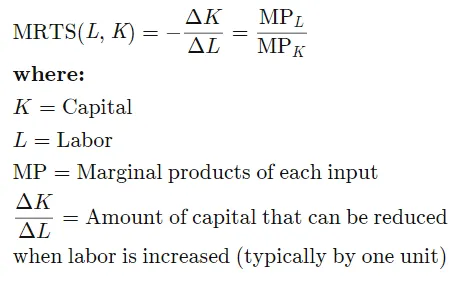
The Formula for the Marginal Rate of Technical Substitution
How to Calculate the MRTS
An isoquant is a graphical representation of the different combinations of capital and labor that can produce the same level of output. The slope of the isoquant represents the Marginal Rate of Technical Substitution, which indicates the amount of capital required to replace one unit of labor at a particular production point. For instance, when capital is plotted on the Y-axis and labor on the X-axis, the MRTS at any point along the isoquant can be calculated as the ratio of the change in labor to the change in capital (dL/dK).
What Information Can You Obtain From the MRTS?
Interpreting the Marginal Rate of Technical Substitution involves analyzing the slope of an isoquant graph. This slope, denoted as the MRTS, elucidates the speed at which one input, be it labor or capital, can replace the other without altering the output level. The MRTS is quantified by the absolute value of the isoquant's slope at a specific point, offering a precise measure of substitution dynamics.
Conclusion
The Marginal Rate of Technical Substitution is a key economic measure, revealing how one input can replace another without affecting output. The isoquant graph illustrates diverse capital-labor combinations for consistent output. By emphasizing producer equilibrium, MRTS distinguishes itself from the consumer-focused Marginal Rate of Substitution. By examining the slope of the isoquant, which represents the MRTS, we can gain valuable insights into substitution dynamics that can guide resource allocation decisions.